
sidetracks & detours, Sunday 1st November 2026: Brothers In Band pay tribute to Dire Straits + Chamber Music Coming To The Camel House in November.
AND DO THE WALK OF LIFE:
bROTHERS iN bAND pay fitting tribute TO DIRE STRAITS

Tonight´s tribute to the album BROTHERS IN ARMS by the real DIRE STRAITS celebrated the album´s fortieth birthday. The album was the fifth studio album by the British Rock Band was released on 17th May 1985 on Vertigo Records internationally and on Warner Bros records in the USA. The original album has a place in history as being the first CD to sell over a million copies in that then new format. Produced by DIRE STRAIT´S bandleader MARK KNOPFLER with sound engineer Neil Dorfsman.
In 2025, to commemorate the 40th anniversary of the album’s original release, the album was re-packaged in several formats, including a five-LP box set and triple CD. This box set included the full studio album as well as a previously unreleased full-length live concert from the band’s show at Municipal Auditorium, San Antonio during the world tour.
Brothers in Arms has been muiscally described musically as an album of pop riock. The Money For Nothing music video f received heavy MTV rotation on , and it was MTV Europe that first aired it., on their launch day of the network on 1 August 1987 It is one of only two Dire Straits songs on a studio album not to be solely credited to Knopfler (the other being “The Carousel Waltz”, which appears on Making Movies album, with Sting as guest vocalist given a co-writing credit due to the melody of the repeated “I want my MTV” (sung by Sting) at the start echoing the melody Don´t Stand So Close To Me by the Police.
The UK single chart housed The Walk Of Life as number two in early 1986 and the US BIllboard Hot 100 carried the song to a number seven hit later that year. The song was nearly left off the album, but was included after the band out-voted producer Neil Dorfsman.
On the second side of the album, three songs (“Ride Across the River”, “The Man’s Too Strong” as well as Brothers In Arms are lyrically focused on militarism.
“Ride Across the River” uses immersive Latin American imagery, with synthesised pan flute, mariachi trumpet, a reggae-influenced drum partaccompanied by an eerie background noises including synthesized cricket chirps.
“The Man’s Too Strong” depicts the character of an ancient soldier (or war criminal) and his fear of showing feelings as a weakness.
The Falklands War, led to the writing, in 1982 of, “Brothers in Arms” deals with the senselessness of war.
In 2007, the 25th anniversary of the war, Knopfler recorded, at Abbey Road, a new version of the song to raise funds for British veterans who he said “are still suffering from the effects of that conflict”.
Initial reviews of Brothers in Arms from the UK music press in 1985 were generally negative. NME published a scathing review by Mat Snow criticising Knopfler’s “lugubriously mannered appropriat mawkish self-pity, his lugubriously mannered appropriation of American, rocking with his thumpingly crass attempts at wit”. He also accused the album of the “tritest would-be melodies in history, the last word in tranquilising chord changes, the most cloying lonesome playing and ultimate in transparently fake troubador sentiment ever to ooze out of a million-dollar recording studio”.
Record Mirror editor Eleanor Levy dismissed the guitars´West coast reeking of mega bucks and sell out stadium concerts throughout the globe. Laid back melodies. Dire Straits – summed up … This is like any other Dire Straits album quarried out of the tottering edifice of Middle Of The Road rock.”
Reviewing the remastered Dire Straits albums in 1996, Rob Beattie of Q , however,awarded Brothers in Arms five stars out of five and wrote that “repeated listening reveals it as a singularly melancholic collection – see the guitar slashing of ‘The Man’s Too Strong’ and the title track, where joy is as sharp as sorrow”.
A BBC Music review in a 2007 review, Chris Jones called Brothers in Arms “a phenomenon on every level… a suite of Knopfler’s very fine brand of JJ Cale-light “.
Stephenn Thomas ErleWineIn offered his retrospective AllMusic review and gave the album four out of five stars, crediting the international success of the album not only to the clever computer-animated video for “Money for Nothing”, but also to Knopfler’s “increased sense of pop songcraft”. According to Erlewine, Dire Straits had “never been so concise or pop-oriented, and it wore well on them”. Erlewine concluded that the album remains “one of their most focused and accomplished albums, and in its succinct pop sense, it’s distinctive within their catalog”.
In 2010, when Brothers in Arms was among ten albums nominated by The Brit Awards for the best British album of the past 30 years Paul Gamabaccini, broadcaster, journalist and author, described the list of nominees as “risible” but added, “Brothers in Arms runs away with it for the quality of songwriting and musicianship.”
Classic Rock, In 2018, stated that Brothers in Arms “made Dire Straits superstars, but it also warped the popular perception of both Knopfler and his band. Dire Straits became a byword for a certain sort of safe, homogenised music, and Knopfler was turned into a caricature of the middle-aged rocker, with jacket sleeves rolled up and wearing a headband […] It wasn’t even as if he had contrived to make a blockbuster. In large part it was hushed and melancholy, a sigh rather than a roar. But it was damned by having its signature single explode out of context.”
I would never have deigned to pay money to see a tribute band of any affiliation when I lived in England. I never liked Elvis impersonators.
However, I have lived here on Lanzarote for twelve years now and maybe it was only because Larry Yaskiel who made me aware of this 40th anniversary concert, or maybe it was a mixture of nostalgia and a respect for the source and the fact that Enland is So Far Away that sent me to the cinema in Arrecife, a venue in which we have seen more than half a dozen provocative and evocative rock bio picks including Aretha Franklin, Elvis Presley, Bruce Springsteen & Bob Dylan.
So at 74, I sat in this very modern cinema complex with its plush surround seats, big screen, massive speakers and endless supplies of popcorn and coca cola, and rested my hands on the top of my now necessary walking stick. I could sit and listen to some songs I have loved since 1985. I knew I wouldn´t / couldn´t possibley attempt the Walk Of Life no matter how near I might be to the finishing line !
ORIGINAL TRACK LISTING OF FIRST RELEASE OF BROTHERS IN ARMS
So Far Away
Money For Nothing
Walk Of Life
Your Latest Trick
Why Worry
Ride Across The River
The Man´s Too Strong
One World
Brothers In Arms
were to be performed in tonight´s concert along with many other much loved hits of Dire Straits by Brothers In Band
We had only been in our seats for a few minuted when we saw our friends Larry and Liz Yaskiel heading towards us, or their seats, whichever came first. it turned out that they would be sitting in the back row only two behind us and Liz breathed a sigh of releif when they got here onm time.Apparantly they had turned upto park in the cinema´s underground car park but Dire Straits and their acolites had drawn such a crowd that the official underground car park was completely full. Liz then found most of the several big wasteland car parks were full too, not only of cars but also of boulders, stones and sinkholes. One of thoise car parks had hadmore ofthe latter but fewer of the cars, so she found a space.
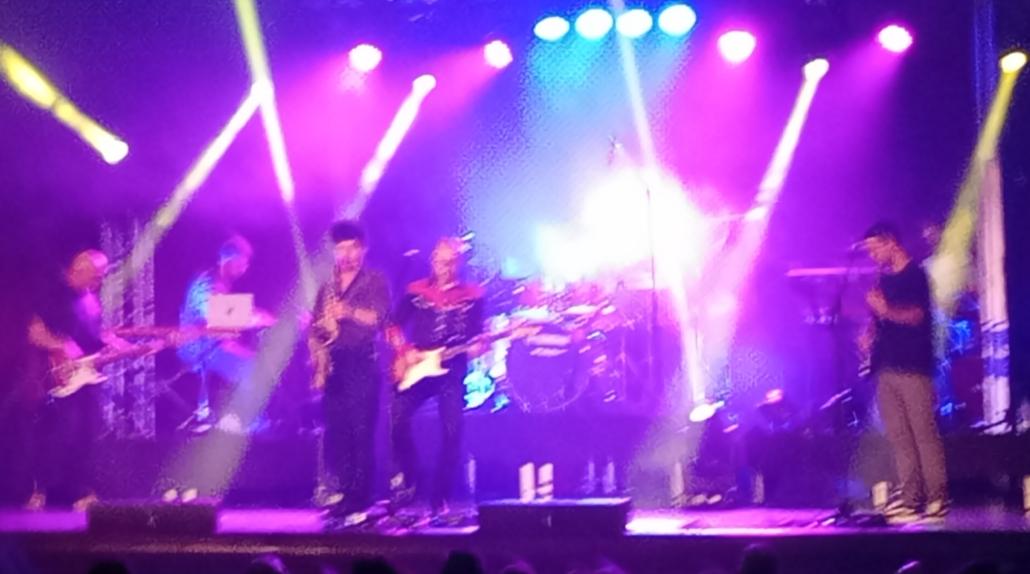
The personnel of tonight´s tribute band included Angelo Fumarola as Lead guitar and vocals (portraying Mark Knopfler), who gave a charismatic performance and delivered some delicious guitar licks. I probably preferred him on the slower tracks such as Why Worry and So Far Away, simply because his vocals in English seemed clearer than on the rockier tracks, but in all honesty I would say that these were probably tracks on the original album release.
Expertly aiding and abetting Angelo was Antonio Abad on rhythm guitar and backing vocals and Fernando Abenza on Electric bass and backing vocals.
Angel Fernandez, I think, was on keyboards and backing vocals and Hector Perez was on percussion and vocals, with Miguel Queixis on drums and with Angel Ruiz on pedal steel guitar.
One musician, Sandor Illua, caught my constant attention whenever he played a solo piece or lengthy accompaniment, partly because his instrument stood aside from the guitar, keyboard and percussion as his saxophone playing re-created the tone that adorned many album tracks by Dire Straits.
The sound system and the lighting effects were superb as this tribute band managed to laud not only the studio album of Brothers In Arms but also captured the energy of Knopfler and the boys in concert, in huge arenas.
Songs like Juliet and Private Investigations, helped the ´war´ songs that served as protest and anger and sympathy for the soldiers.
The three guitars complemented each other and all their fellow instruments we heard tonight and whenever the music required Angelo to step forward he was definitely up for it. Nevertheless, he captured the head down concentration of Knopfler whenever he was playing the finger-tipped trills that so often added poignancy to the sound.
There was a clever, (very) long-fading outro to the concert and it might even have been possible that every person in the sold out 600 seater hall could have picked a different song on which to crown the evening. I had already had mine and, being greedy, I will forever carry around in my head the memory of Juliet and Walking In The Wild West End.
Whatever songs anyone in the audience was waiting to hear the final song was, to my surprise, The Sultans Of Swing. That is a wonderful song that was their first hit that immediately told us that whatever their choice of group name Knopfler´´s men would never in the so many senses would never have to worry about falling into dire straits in he future.
Obviously knowing they couldn´t top The Sultans Of Swing we all shown the way out accompanied by perhaps the orginal recorded Saturday night at the movies, (a clever little advert by this cinema that, of course,normally shows films). As we truend to the exit I saw Larry a couple of yards ahead of us, singing the words and giving them old soft shoe shuffle and loving evry minute of it.
From the fillets of conversation we overheard on our exit we can speak truly and say that every person we heard seemed delighted in what they had heard. The concert had started at dead on 8.00 pm and the the clock on the church tower pointed out to us that we had missed the we had missed the chiming of ten pm by fifteen minutes.
So as we said our farewells outside the cinema in which we had sat transfixed for over 2 hours, Larry started talking about a concert of Dire Straits that he was really hoping was going to be renacted tonight and he kept mentioning Wembley which, to be honest, I didn´t really remember, perhaps because I never saw them play live anywhere.
Although he beats me by a million miles of memory in our regular Pop Master questions we pepper on to our conversations, I nevertheless made a note to self to check it out on my computer as soon as I got home.
I always ask people, when I can´t remember a fact at all, why I should ever try to retain a fact in my mind when I know I could find the answer´(s) on line.
In fact I would have needed room for three answers in my head as Google told me that for Live Aid (July 13, 1985) Dire Straits performed a famous set at Wembley Stadium, which included “Money for Nothing” with Sting, on the same day they were running a multi-night residency next door.
For Nelson Mandela´s 70th Birthday Tribute (June 11, 1988), Knopfler et al played a major headlining and backing set at Wembley Stadium, famously joined on stage by Eric Clapton.
During their peak Brothers in Arms tour in July 1985, they played a massive multi-night residency at the adjacent Wembley Arena (including notable guest appearances by Hank Marvin and Nils Lofgren), and returned for shows on later tours like On Every Street in 1991. You can read more about their history via the Dire Straits Timeline and insights on Dire Straits Blog.
So by 8.30 am on the morning after the tribute paid to Dire Straits on Lanzarote I am already down 3-0 to Larry even before we meet again.
Meanwhile, I have just recieved a copy of the What´s On Lanzarote newsletter. I wrote for the organisation for three or four years and the owner and editor, who works under the psyedonym of MIguel, somehow always managed to cut my stories with an editor´s eye in a way that didn´t damage the stroy or the tone, anbd i was always very grateful for that.
You will note, though, that Miguel´s own review, below, is somewhat more succint about the Dire Straits tribute act than my ramblings around the sidetracks & detorus of the event. He get´s it spot on !
The Dire Straits tribute concert at the theatre was superb – the seven musicians were really polished and professional, as you’d expect, as they’ve been touring the set around the world for some time.
The “Mark Knopfler” of the band was a little shorter than the real thing, but just as extraordinarily talented on the various guitars he played. His vocals were also spot on – as indistinct and lazy as Knopfler’s!


JUST FOLLOW YOUR ART
TO ISLANDLIFE
CHAMBER MUSIC: COMING TO THE CAMEL HOUSE
On Friday the 6th November 2026, we are delighted to welcome THE REINECKE TRIO from Italy (Trentino). They will be bringing with them a wealth of musical gems from the 19th and 20th centuries.
And on Saturday 28th November, the venue will welcoming guests from Tenerife: for the third time, THE IKARO QUARTET will be performing for us with a mix of classical and contemporary compositions.
Make a note of the dates.
Tickets through our website
camelhouse-lanzarote.com or by email
info@camelhouse-lanzarote.com or phone
0034 658 268 942
Kind regards
Danielle and Rolan
THE REINECKE TRIO,
Friday 6th November, preview
Op. 274, was composed in 1905, is one of the composer’s later works and represents a perfect synthesis of his mature musical language. The work was originally written for clarinet, French horn and piano, but is often performed in an alternative version with viola instead of the French horn. This transcription slightly alters the sonic balance, making the dialogue between the instruments more intimate and gentle, without altering the structure or spirit of the composition.
The Swedish violinist and composer John Jacobsson left behind a refined and evocative chamber music repertoire.
In the Three Pieces for Clarinet, Viola and Piano, a balance emerges between expressiveness and lightness: the lyrical ‘Phantasiestück’ is characterised by fluid, cantabile writing, followed by the more introspective ‘Lyrical Intermezzo’, and concluding with the sparkling ‘Humoresque’, which brims with energy and rhythmic vitality.
Robert Kahn’s Serenade, Op. 73, composed in 1923, is a fascinating chamber work that embodies the sophistication and refinement of the German musical language of the period. Kahn, a German Romantic composer, creates a work of highly elegant composition, characterised by great attention to instrumental textures. The Serenade unfolds through a series of contrasting moments, ranging from lightness and grace to profound emotional introspection. It is distinguished by its freshness and vitality, as well as by its sweet and harmonious melodies; the writing is light and airy, with a perfect balance between the three instruments, which engage in a fluid and effortless dialogue. The music moves forward dynamically, creating a cheerful and lively atmosphere. The serenade concludes with variations on an original theme, which transforms in a surprising way, shifting from light and playful moments to more intense and dramatic ones.
One of the most important composers who helped to expand the repertoire for this ensemble was the German Robert Schumann, who, with his *Märchenerzählungen*, Op. 132, for clarinet, viola and piano, expresses a romantic world through fairy-tale imagery that appeals to the individual memory of each listener. His influence on the nineteenth-century musical landscape was considerable, and his contribution to musical Romanticism made him a central figure in the history of Western music.
Max Bruch’s Eight Pieces, Op. 83, composed in 1910, belong to the composer’s late period, when he was seventy-two years old. The set, like his Concerto for clarinet, viola and orchestra in E flat minor, Op. 88, was dedicated to his son Max Felix, a professional clarinettist. Although the date of composition coincides with the height of the avant-garde movements of the 20th century, Bruch chose to remain faithful to the musical language of German Romanticism. This programme offers a selection of three of the eight original pieces. The Andante in A minor serves as an introduction to the cycle. It is followed by the third piece, significantly titled ‘Melodie’, which is set at an Andante con moto tempo. The programme concludes with the penultimate piece, an Allegro vivace ma non troppo, whose formal structure is more complex than that of the previous movements. Although Bruch conceived the Eight Pieces as eight short, independent works, their contrasting yet complementary characteristics make them particularly well-suited to being performed as a cycle.
Of Swiss origin, though active in both Russia and Germany, Paul Juon is known for his ability to fuse the Romantic tradition with Slavic influences. The Trio-Miniaturen are short pieces of great expressiveness and stylistic variety: the dreamy Rêverie, the brilliant Humoreske, the melancholic Elegie and the lively Danse phantastique paint a fascinating musical mosaic, highlighting the trio’s timbral versatility

THE IKARO QUARTET
Saturday 28th November, preview
The Ikaro Quartet is a String quartet founded in 2023 in Tenerife, Spain
The line-up includes two violins (Juan Manuel Díaz and Ibella Suárez), one viola (Ewa Moszczynska) and one cello (Kathleen Balfe).
Ikaro Quartet fuses traditional classical music with popular genres such as rock, pop, and jazz.
They perform as the official group for the Candlelight concerts in the Canary Islands, playing soundtracks (such as The Lord of the Rings or Hans Zimmer) and tributes to artists such as Queen.

Nick Tomalin’s ‘Shades of Shearing’ Quintet
preview. Jazz at Progress Friday 27 November 2026
Nick Tomalin piano
James Larter vibraphone
Dave Warren guitar
Dominic Howles double bass
Matt Fishwick drums
Blind from birth and the youngest of nine children, George Shearing overcame the abject poverty and difficulties of his childhood in Battersea to become one of the most popular and influential pianists of his generation.
Born on 13th August 1919, his remarkable natural talent and gift of total recall was evident from his earliest days – by the age of three he could pick out tunes on his family’s battered piano. He later received formal music tuition at Linden Hall School for the Blind, learning to read music by Braille and developing a formidable technique on both the piano and the accordion. By his mid-teens he was a member of Claude Bampton’s All Blind Band and by 1939 he had made his first recordings for the Decca label and broadcasts for the BBC
Within a short time of emigrating to America in 1947, Shearing was recording with vocalist Sarah Vaughan and fully involved in the vibrant jazz scene of New York’s 52nd Street. His highly personal piano style, combining the inventive excitement of Bud Powell with the locked-hands technique of playing block chords pioneered by Milt Buckner, was certainly ‘knocking the fans for dead’. But it was his innovative quintet of 1949 – piano, vibes, guitar, bass and drums – that really caught the public imagination with hit recordings like ‘September in the Rain’, ‘Conception’ and ‘Lullaby of Birdland’ and witty titles like ‘Sorry, Wrong Rhumba’..
A succession of great musicians passed through the ranks of the quintet over the next three decades, including vibists Margie Hyams, Cal Tjader and Gary Burton, guitarists Chuck Wayne, Toots Thielemans and Joe Pass, bassist Israel Crosby and drummer Denzil Best, composer of the bebop classic ‘Move’. The 1958 edition of the band was captured in action at the Newport Jazz Festival in a milestone jazz documentary.
Shearing’s success also inspired collaborations with vocalists Peggy Lee, Ernestine Anderson, Mel Torme and notably Nat King Cole; who could ever forget the glorious piano introduction to ‘Let There be Love’?
In his post-quintet career Shearing reached new heights of expression in both orchestral settings and the intimacy of small groups. He was appointed OBE in 1996 and knighted in 2007.
‘So’, he noted later, ‘the poor, blind kid from Battersea became Sir George Shearing. Now that’s a fairy tale come true.’
He died on 14th February 2011
.

NICK TOMALIN formed his ‘Shades of Shearing’ Quintet in 2021 to celebrate the remarkable musical legacy of George Shearing. A graduate of Leeds College of Music and the Guildhall School of Music & Drama, Nick enjoyed the thrilling opportunity to feature in a 1994 televised masterclass with Sir George himself.
Nick’s tasteful bebop-inspired piano style has made him a regular on the London scene for nearly thirty years. He has worked with some of the biggest names in UK jazz including Jim Mullen, Mark Lockheart, Alan Barnes, and Stan Sulzman among many others. He has recorded seven albums with saxophonist Mark Allaway, most recently Jeru: The Music of Gerry Mulligan
DAVID WARREN is a highly regarded jazz guitarist and regular performer at Ronnie Scott’s with his own quartet. A graduate of the Purcell School and the Guildhall School of Music & Drama, he also studied in the USA with guitarists Bucky Pizzarelli and Vic Juris. His career includes performances with the bands of Dick Pearce, Renato D’Aiello, Alison Neale and the London Jazz Orchestra, as well as the star-studded Music for Montserrat concert at the Royal Albert Hall.
JAMES LARTER is a versatile percussionist, vibraphonist and composer whose work spans jazz, contemporary music and a wide range of other styles. His collaborations include artists such as Sampha, Berlioz and Gang of Youths, alongside performances with the London Philharmonic Orchestra, the Philharmonia and English National Opera. A 2021 City Music Foundation Artist, he released his debut album, Polarity, in 2022, showcasing his distinctive approach to percussion, marimba and vibraphone.
DOMINIC HOWELS is an accomplished double bassist, composer and arranger who has been a fixture on the British jazz scene for more than three decades. After studying jazz and studio music at the Guildhall School of Music & Drama, he went on to perform and record with artists including Stacey Kent, Anita Wardell, Christine Tobin, Bobby Wellins, Don Weller and Julian Siegel. He leads his own groups and has released several albums featuring his original compositions and arrangements, including Bristolian Thoroughfare and Along Came Benny.
MATT FISHWICK is one of the most respected drummers on the UK jazz scene. After studying at the Royal Academy of Music, he worked in both London and New York, performing at celebrated venues including Ronnie Scott’s, Smalls and the Iridium. His extensive list of musical collaborators includes jazz greats Cedar Walton, Scott Hamilton, Harry Allen, George Mraz, Larry Coryell and John Colianni. He continues to perform widely in the UK and Europe.
“Well worth checking out, especially if you’re a Shearing fan. If you’re not, I guarantee you soon will be!” – Lance Liddle (Bebop Spoken Here)


Leave a Reply
Want to join the discussion?Feel free to contribute!