
SIDETRACKS & DETOURS Sunday 19th July 2026: WORKING IN A COAL MINE or a car repair shop with LEE DORSEY + PARRANDA JANUBIO celebrate 40th anniversary of music, + the closing football games of The World Cup
LEE DORSEY
working in a coal mine
and Norman Warwick decided to Lendanear
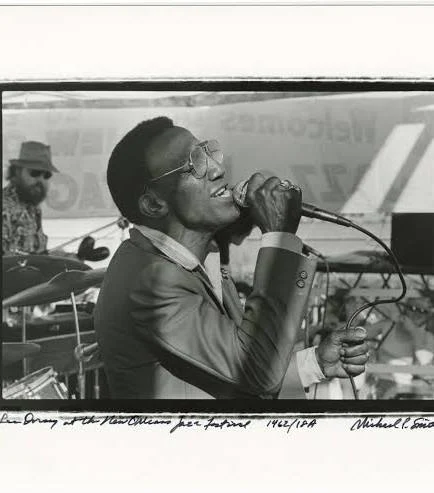
No singer in the Big Easy had a more easy-going manner than Lee Dorsey (right).. The rhythms behind him could be wickedly syncopated (they usually were), and Dorsey would still sound unruffled, unhurried, as if it were a sunny afternoon and he had nothing better to do than sit on his front-porch swing and watch a boisterous, second-line parade go by.
Just listen to the way he sings his first big hit, 1961’s Ya Ya. He drawls out the words, “Oh, well, I m sitting here la la, waiting for my ya ya,” filling up every vowel with a happy-go-lucky hum. His buttery, slightly nasal, baritone croon is immediately relaxing. The singer is sitting around, waiting for his girlfriend to show up, but it hardly matters whether she does, because he’s already feeling fine. He’s got the bouncy exuberance of the catchy little piano figure; he’s got the
laid-back serenity of his own vocals—who could ask for anything more? Certainly not his listeners, who can’t help but envy a man so content that the arrival of his lover would be mere icing on the cake.

´
´Lee had what I look to call a smiling voice´, said Dorsey´s most frequent songwriter and producer , )left)Allen Toussaint,. ´When you hear his voice n just about any song, it sounds like a smile. He had a free-hearted spirit for life, and one could hear that in his voice—his voice had a lift to it´.
The same sunny singing, the same effortless funkiness can be heard in Dorsey other hit singles
:
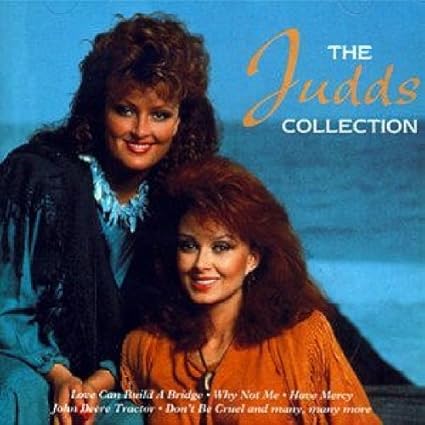
Working In The Coal Mine (later re-fashioned by both Devo and The Judds,Left)),Get Out Of My Life Woman (re-recorded by Paul Butterfield, Joe Tex, and, as an instrumental, by Toussaint), Holy Cow (remade by The Band), and Do-Re-Mi (later redone by Dusty Springfield). Dorseys original recordings of these songs can now be found on Arista’s twenty-song, single-CD anthology Wheelin’ and Dealin: The Definitive Collection.
Twenty different Dorsey songs are on another crucial set, Yes We Can and Then Some (Polydor Chronicles), including such key cuts as Yes We Can (later a hit for The Pointer Sisters) and Sneakin’ Sally Thru The Alley (remade by Robert Palmer). Taken all together, these forty songs (plus the nine on his marvellous 1978 valedictory album, Night People) represent a body of work so rich and influential that it prompts the question, “Why isn’t this man in the Rock and Roll Hall of Fame?”
The answer is lost in the Vatican-like secrecy of Hall-of-Fame voting. But other questions arise as well. For instance, how could a voice sound so sanguine amid the rugged push-and-pull of New Orleans syncopation?
In most cities, total relaxation means an absence of movement, but in New Orleans, it means an absence of inhibition. Remove all tension, and the body will not hibernate but will undulate—not sink like a stone through the rhythms of the streets, but float upon them like a cork
.
That’s what we hear in Dorsey’s singing—a buoyant voice that rides the waves beneath him. Just listen to Working I The Coal Mine, where a high-squeaking guitar and a low-throated baritone saxophone tug the beat back and forth. The song takes on one of those memorable New Orleans grooves that we hear with the hips as much as the ears. And yet there’s no danger of Dorsey’s airy vocal losing its place in the staggered rhythm. And that’s the joke of the song—even a job as dreary as coal mining can’t make the singer worry or lose his way.
How could a man who was so mellow and carefree be patient and stubborn enough to achieve the intricate craftsmanship of these songs? The trick lay in a brilliant division of labour between Dorsey and Toussaint. Each supplied what the other lacked. When Dorsey stepped up to the microphone, he filled the moment. He had that creamy voice, that irrepressible optimism, and a knack for bringing them to the fore the moment the song started. What he didn’t have was the dogged patience to peck out a melody on the piano, instead he fingered it slightly differently each time until it sounded surprising and familiar all at once. He also didn’t have the determination to link words to music, drums to bass, guitar to piano, or lead to harmony, building a song gear-by-gear until it ran like clockwork. That was Toussaint’s job, and he was brilliant at it. What Toussaint didn’t have was the sensual voice, the stage-front charisma to bring his clock-like creations to life. They needed each other—the short, wiry singer who always seemed to be photographed with all his teeth shining in a big grin, and the tall, stately, mustached producer in the dapper suits.
´When a certain kind of song came knocking´, Toussaint remembers, ´I knew right away if it were a Lee Dorsey song, because there was subject matter Lee could sing that wouldn’t work with someone who had a more serious or debonair attitude. For Lee, I could write about working in a coal mine, about taking a trip to Mexico, about riding a pony, songs where you don’t take things so seriously that you can’t enjoy the flowers. Who else could sing Holy Cow? Anyone else would be too hip for it. But Lee was as relaxed in life as he was in the studio. He was definitely a live-and-let-live person, a very free spirit´.
Irving Lee Dorsey was born in New Orleans’ Ninth Ward on December 24, 1924. He and some other kids used to tease an overweight neighborhood friend who always had to stay inside and practice the piano. They called him “Fats” and the nickname stuck—Antoine “Fats” Domino. When Dorsey was ten years old, his parents moved to Portland, Oregon, and it was there that the youngster became a fan of the Grand Ole Opry and learned to yodel like Jimmie Rodgers.
´Lee straddled the fence between blues and country´, Toussaint insists. ´In his music, those two elements come into contact quite openly. On a song like Lover Of Love, you hear a country feel, but also a lot of blues. Those two genres have a lot more in common than most people think. If you hear a good, sincere country song, it can get as bluesy as blues can get´.
Dorsey was drafted into the Navy and saw action in the South Pacific during World War II. After the war, he was billed as “Kid Chocolate” and became one of the Northwest’s top featherweight and lightweight boxers. Then in 1955, he gave up the sport and moved back to New Orleans. He studied body and fender repair under the G.I. Bill and soon landed a job in a shop owned by local disc jockey Ernie the Whip.
´I used to sing to make my work go easier´, Dorsey told author Jeff Hannusch in his invaluable book I Hear You Knockin
´I wasn’t thinking of making no records. But one day this guy came in to get his car fixed—Reynauld Richard. I was up under a car hammering and singing away, and he said, ‘Hey, you want to make a record?’ I said, ‘Sure.’ I didn’t think he was serious. But he was.”
Richard was a local record promoter, and he helped Dorsey cut several singles in 1957. On one of them, Lottie-Mo, producer Harold Battiste brought in the young pianist Allen Toussaint to play one of his signature riffs. Thus began the long association between the two.
Lottie-Mo didn’t sell a lot of copies, but it did catch the ear of Marshall Sehorn, a promotion man for Fire/Fury Records, who alerted his New York boss, Bobby Robinson, who came down to New Orleans and discovered that Dorsey had a wonderful voice but no original material. As the label owner and singer sat on Dorsey’s front porch, trying to think of songs to record, they heard some kids across the street clapping and chanting a nursery rhyme, “Sitting on the la la, yeah, yeah.” Robinson called the kids over and had them sing it again until Dorsey had learned it. Then the two adults repaired to a bar and wrote out new lyrics on a napkin. That was Ya Ya, and it was recorded with Toussaint on piano and Dominos Red Tyler on saxophone. It quickly became a national smash, topping the r&b charts and rising to number seven on the pop charts. Dorsey quickly followed it up with another nursery rhyme song, Earl King’s “Do-Re-Mi,” which became a top thirty hit. The momentum stalled, however, when Fire/Fury went into receivership and Toussaint went into the military.
In 1965 Toussaint formed a partnership with Sehorn, and one of their first projects was recording Dorsey. Toussaint wrote and produced Ride Your Pony, a cowboy song brimming with sexual innuendo, and it featured Dorsey’s bubbly voice gliding above a funky groove, with a chink-a-chink rhythm guitar pushing against a percolating bass line and baritone sax-honks. It was a top ten r&b hit and a top thirty pop single, and it kicked off a string of Toussaint/Dorsey hits: Get Out Of My Life Woman (#5 r&b, #44 pop), Working in the Coal Mine (#5 r&b, #8 pop), Holy Cow (#10 r&b, #23 pop), Go-Go Girl (#31 r&b), and Everything I Do Gonna Be Funky (From Now On) (#33 r&b).
´I had this way of writing for Lee where Willie Harper and I would start singing together and we’d put Lee’s voice in the middle´, reveals Toussaint. ´For example, Lee never sang the whole line, ‘working in the coal mine’; he just sang ‘working,’ and Willie and I sang the rest. Get Out Of My Life Woman was another one of those songs that we had that fun formula where the backups would sing half the song. We’d sing every other line in a call-and-response pattern. There was no question where the lead was, because once you heard Lee Dorsey’s voice, you knew that was what it was all about´.
In 1970 Toussaint tried to transform Dorsey into a progressive-soul album artist similar to Curtis Mayfield or Marvin Gaye. The producer wrote some brilliant songs about black pride and solidarity (Yes We Can—also called Yes We Can Can—and Who’s Gonna Help Brother Get Further?, about class issues, and When The Bill’s Paid and On Your Way Down, and about Louisiana’s distinctive culture (Riverboat and Gator Tail), and Dorsey sang them with an ebullience that captured the optimism of the era. The 1970 album Yes We Can, and its 1978 follow-up, Night People, were artistic triumphs but commercial failures.

Dorsey didn’t care; he went back to working on cars. He appeared almost every year at the New Orleans Jazz Festival, and he toured with The Clash in 1980. For the most part, though, he was content to work in his auto shop, singing to himself as he straightened out dents and bumps. He died of emphysema on December 1, 1986.
´If he had a record out that was doing fairly well´, Toussaint explained, ´he’d go out and perform. But after a while, as the popularity of a recording diminished, he’d retire into the body-and-fender shop where he was very happy and was around a lot of his buddies and family having a great time bending fenders.
´He loved recording and the stage thing, but he knew he had another life that he could trust and was very good at it. It was not like a demotion to go back to that. His fender work was artistic as well, and he was proud of it. One time he wanted a Cadillac, so he just built himself one. After a few months of visits to the junkyard, he put together a beautiful—and I mean flawless—Cadillac. If things were slow in one area, he always had the other. Maybe that’s why he sounded so carefree when he sang´.

Music & Emotion in Playa Blanca
9.00 pm Sunday 12th July 2027
PARRANDA JANUBIO celebrates its 40th anniversary review by Norman Warwick
To celebrate playing in the town square in front of the beautiful church in Playa Blanca Parranda Janubio invited Begoña Quintero, Iván Díaz and the brothers José Manuel and Leo García Corujo, four great voices from the archipelago
We had enjoyed hearing Parranda Janubio already celebrating its first four decades of their musical career last June in Las Breñas, when they had opened a concert by the great Acatife band. That had been a fantastic night and you can find the report of that event in our edition published on xxxx under the title of xxxxx, in our easy to negotiate archives of over 1,800 free to read arts related articles..
However, because Parranda Janubio have always been linked to the southern celebrations of the Virgen del Carmen, they took to the festive stage on Sunday 12th July Juluin our home town of Playa Blanca. We decided to make a full night of it, as the concert was due to begin at 9.00 pm and headed out for a pre-concert meal at Le Gondola, currently one of our favourite local restaurants near the town beach. There was a real buzz along the sea path down into the centre of town, as local residents were out in all their finery with their ever noticeable pride in the community, There also seemed to be a signify cant rise in the number of tourists, of mostly young families able to be here now that the schools in the UK and mostly across Europe are into the summer school holidays. It was our favourite waiter who served us in The Gondola and delivered our tapas portions of canaria potatoes with sauces and salt and then a pasta dish, washed down with my cervaza sin alcohol and Dee´s white wine.
We enjoyed our long, slow supper until, at 8.45, we decided to take the five minute stroll up the town square to choose our seats for this free concert.
We were treated to a carefully curated repertoire of Canarian folklore, as Parranda Janubio had invited Begoña Quintero, Iván Díaz and the brothers José Manuel and Leo García Corujo, four great voices of the archipelago.
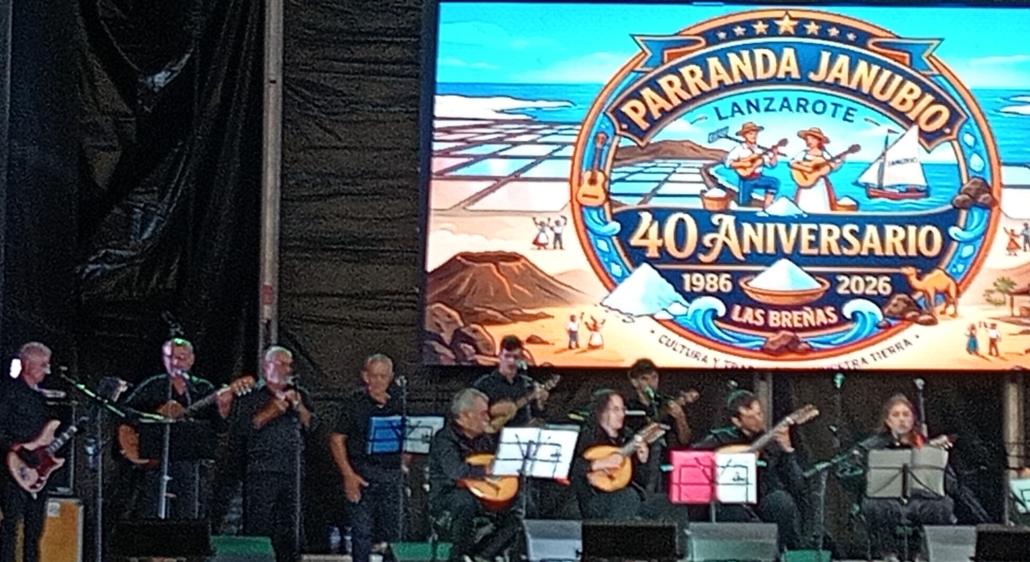
The Janubio Folk Music Gathering, presented by Leandro Martín, was a true gift of emotion for an audience that was able to enjoy the 40th anniversary of the folk group led by Clotildo Martín. Of the original members of Janubio, from that group of passionate founders who spearheaded the creation of the group in 1986 in Las Breñas, Clotildo Martín (strings) and Leonardo Cabrera (vocals) are still active.
And from the musically trained youth of Janubio, there is real evidence of the continuity and musical growth of young people who began singing and playing instruments from a very young age, among them Fabio Cabrera, just as young Aarón Fusari does today, with such flair, playing the timple. Elena Acosta, president of Janubio, was unable to perform, but her colleagues conveyed a heartfelt message of affection to her.
Janubio is a deeply grateful group, so during their performance they took a few minutes to thank all the people and organizations that collaborate and have collaborated with them throughout their fruitful artistic career. The Councilor for Festivities of Yaiza, Daniel Medina, received a gift on behalf of the Town Hall: a pair of espadrilles that symbolize not only the group’s journey and the legacy they have left, but also their enthusiasm for continuing along the path of music and tradition
The ´borough´ of Yaiza, of which Playa Blanca is a part, publicly praises Janubio’s contribution to Canarian folklore and its tireless work promoting popular music among young people. The group will surely continue sharing malagueñas, folías, seguidillas, and isas, celebrating the songs of ther late poet Víctor Fernández Gopar and demonstrating in every performance their love for the municipality of Yaiza, a feeling made of poetry and music.
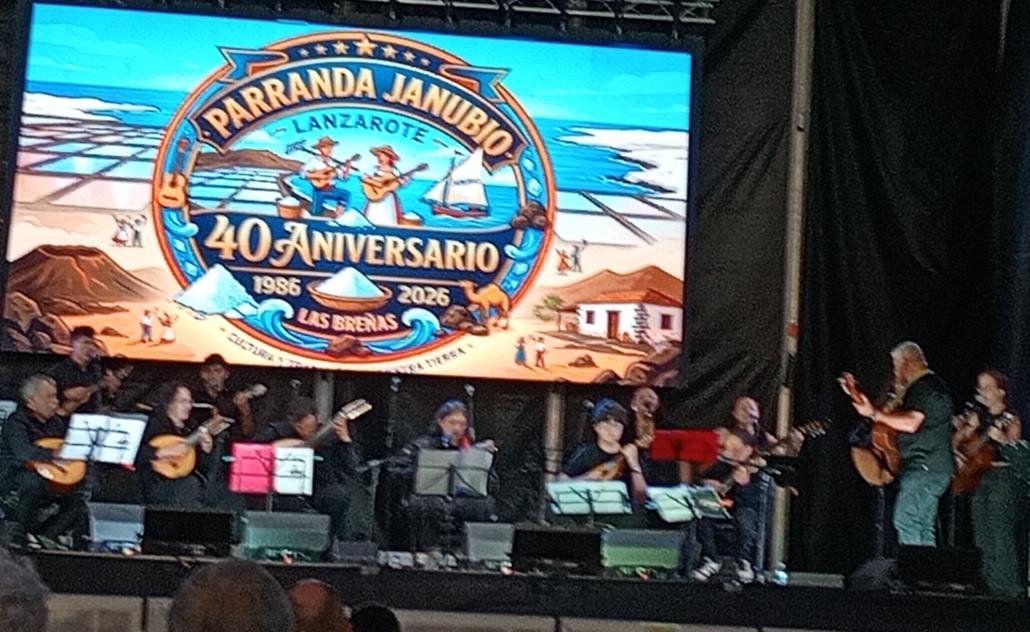
The spoken –word interventions of history and information about writers and singers etc are fairly frequent, fairly lengthy and, rightly, of course, are delivered in Spanish. All that changes the nature of what would normally be a more free-flowing concert, and I couldn´t imagine the Glastonbury Glampers accepting these lessons, mid show, with such alacrity. However the fact that the indigenous people of Lanzarote, and The Canary Islands, wear their pride on their sleeves is so much a part of the charm of these events.
So, too, does their habit of applauding particular parts of a vocal or instrumental, during the song rather than only at the end. There were songs here of sea swells and sea shells, of sun sea and sand and colours of the challenge and chaos of the historic volcanic eruptions of four hundred year ago that even today still influence our way of life here. The twenty or so musicians and vocalists on the stage played at times as a tour de force and at others as soft as a sigh. There were songs we have come to know in our ten years of living on the island, and there were new songs to add to our understanding of the folklore.
Finally, though, there was a solo guitar pick of a tune that I know damned well from my knowledge and love of Americana music. What I don´t know, yet, is which tune pre-dates the other but I do know that after the emigration from The Canary Islands to San Antonio Texas, a lot of Canarian music was adapted into the songs that were sung round the camp fires whenever the cattle drives settled for the nights. And there was that cowboy song ringing out across the Church Square in the second quarter of the first hundred years of the 21st Century.
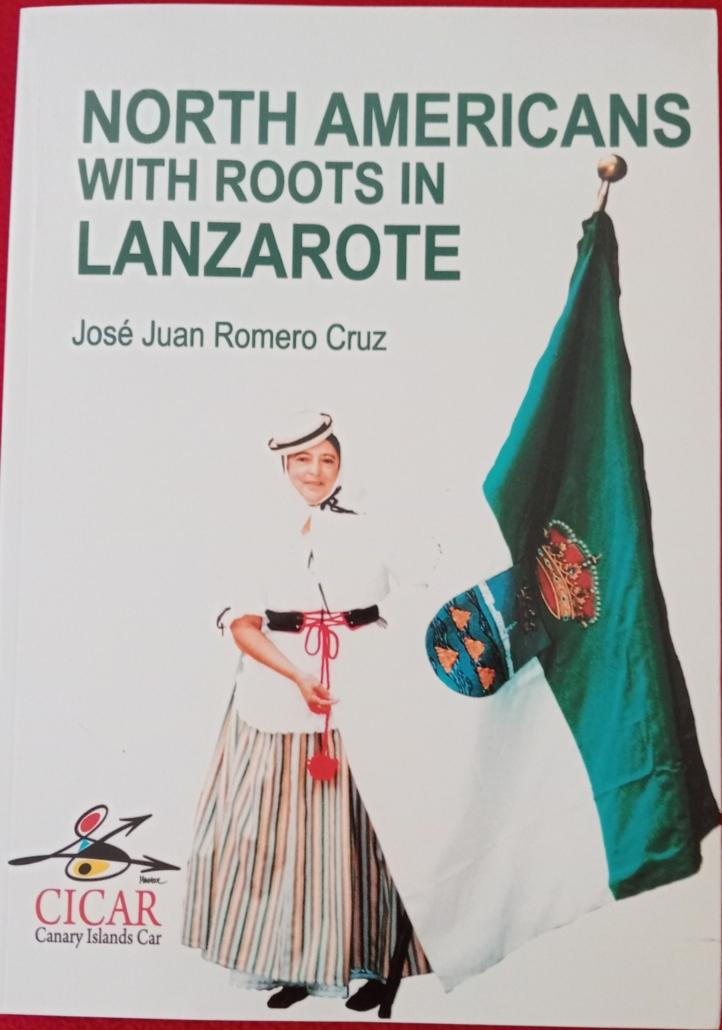
To learn more about this phenomenon, look out for any folk lore concerts held here on Lanzarote and look out for a wonderful English-Language version of book by Jose´ Juan Romero Cruz, in which he tells of North Americans With Roots In Lanzarote.
Playa Blanca completed its first weekend of festivities with high audience figures. Humour, creativity, and tradition came together in the town centre.

So the Town Hall facilitated the screening of the Spain-France World Cup match on Tuesday, July 14th, as the game was shown on a giant screen in the town square at 8:00 PM. Of course, I couldn´t resist attending that, having watched every previous match in this world cup alone in my tv room at home. Obviously, England would be playing the winners of this match, so I could go and watch it, make some notes and send them off to Engand´s German manager to help him refresh his tactics after beating Argentina and Messi in the second cemi final.
What could possibly go wrong?
Well, as walked down into town carrying our fold up chairs on our shoulders to watch the Spain versus France cemi final on the big screen I had yet another fall, perhaps because I was walking to fast. As I always say, there is no soft place to fall on Lanzarote, and this morning, Wednesday 15th July I have new cuts and bruises that, as if by magic or curse, have appeared between the fading cuts and bruises from the previous occasion. A couple of guys helped me up, sat me on a chair and a lady came across with a handful of tissue to clean up my wounds. Yes, yes, thank you all for your help, but can I go now? There´s a match on.
In all the years of watching major live concerts in this sqaure we were amazed to see that all the seats provided by the council were taken and the perimeters of the square were lined by six or seven rows of fans standing up. We set out our chairs, but could only catch fleeting images of the screen, but the Spanish commentator kept us informed and we could tell by the pitch of his presentation, high voiced, fast and loud whenever Spain were in possession, which seemed to be nearly all the time, His tone was quiter, slower and sounding terrfied whenever France had the ball. He usually laughed off his worried tone whenever MBappe fell over,…just like me, only I don´t try to claim a penalty every time !
So, as you all probably know, Spain were awarded a penalty, that was definitely a penalty, and we actually had a good view of that goal.
The crowd at this special screening, mostly young parents and their teenage children, gave a raucous, but somehow restrained reception to he goal. No bottles or beers were thrown, just lads raising their arms to the Gods and the girls dancing in delight before it was hugs and kisses all round. That was ok, we coulñd put up with that.
An hour later, although the match was still not without jeopardy, a second goal for Spain and even better Spanish goal that was disallowed for a very marginal offside decision, relaxed the crowd outside the church and we all knew, then, that their prayers had been answered.
So tonight I will watch England play Argentina on my television, with a couple of cervazos sin alcohol, to lend my support so that we can have a wonderful Spain v England final
What could possibley go wrong?
Well,…..the manager had definitely gone wrong with his substitutions after England had gone one nil up against Argentina, and then the players tired mentally and physically,….all part of a familiar failing by England.
Nevertheless, England will now play ina meaningless match against France, whohad been seen as tournamentys favourites until they met Spain.
So last night I settled down to watch a match without jeopardy, a fixture created to bring one more revenue-providing game as FIFA are trying to keep the customer satsfied.
What could possiblgo wrong? Well, nothing went wrong for the first forty five minutes. England ran rings around a France who looked as iof they were strolling in the park looking for a place to enjoy a picnic. At half time we (England) were leading by four excellent by excellent goals to no goals at all. The rot set in, though, as soon as the kick off for the second hafl was taken, and after only tweve minutes France had scored three goasls and MBappe had become the competition´s leading scorer. Suddenly 4.0 had become 4-3 and the next ten minutes England held on by sheer luck, until the hydration break. Mr. Tuchel took the opportunity to put some substitues on including some of ther headliners like Bellingham. Becausehe had learned his lesson about the best way to defend i to attack England begant o becoime something of a threat again, even whilst France were missing chnce after chane. On a breakaway England won a penalty, which Sacha took to earn himslef a hat-trick and free match-ball, which apparently cost 1,800euros. For the last five minutes of the match England defended desperately, but with two minutes left France scored again and I had a nightmare that they were going to score an equaliser that would have takent his meaningless but masgical match into extra time. However, showing a lot of determination England were clinging but two good tacksles and an inspired pass u to Bellingham on the half way line saw England´s new saviour drible at pace past three tiring French players on his way to their goal, to slam the ball pasttheir goalkeeper to make England 6-4 winners of the >bronze Medal.
So now Lanzarote is showing a live screening of today´s (Sunday 19th July 2027) for up to 50,000 fans ( I´m guessing 98% Spanish and 1% might be English now living in reidence on the island and 1% who might want anyone except Argentinato to win ! So it should be a great atmosphere, and Spain should win,…..,.,, so, there is also a scrrening scheduled on Arrieta beach, too.
Miguel, of Lanzarote Information, has written in hs weekly newsletter of his memories of when Spain last won the World Cup, and how he and his family painted their faces in the colours of Spain´s team shirt, sang all the ´champions´ songs in Spanish and generally had a great time in a wonderful atmosphere. And now that joyous atmosphere is being recreated all over again,…..
what could possibley go wrong???
We´ll discuss that next Sunday, when its all over.,…but meanwhile, COME ON, SPAIN !!!
SIDETRACKS & DETOURS SUNDAY JULY 26th 2026
jazz and classical music explore themes of unity and social progres
featurng
Wynton Marsalis

SIDETRACKS& DETOURS SUNDAY AUGUST 2nd 2026
Songwriters & Invisible Angels chapter 3
by Peter Pearson and Norman Warwick
featuring
Kate Wolf and Julie Matthews
SIDETRACKS & DETOURS SUNDAY 9th AUGUST
a year as poet laureate
featuring
´´Sammy Weaver
SIDETRACKS & DETOURS SUNDAY 16th AUGUST 2nd 2026
Michael: a film about art for arts´sake ?
SIDETRACKS & DETOURS SUNDAY 23rd august 2026
Buddy Mondlock is a songwriter !
SIDETRACKS & DETOURS SUNDAY 30th AUGUST 2026
Too Darn Hot: live jazz
SIDETRACKS & DETOURS SUNDAY 6th SEPTEMBER 2026
Canary Cruising,…cool
SIDETRACKS & DETOURS SUNDAY 13th SEPTEMBER 202
secretly recorded live gigs legitimised on line?
SIDETRACKS & DETOURS SUNDAY 20th SEPTEMBER 2026
Waiting For Godot and Music At Lunchtomes
SIDETRACKS & DETOURS SUNDAY 27th SEPTEMBER 2026
r.i.p. David Alan Coe, songwriter and unreliable narrator


Leave a Reply
Want to join the discussion?Feel free to contribute!